Wednesday, March 7, 2012

Humans vs. Sheep....which is easier to clone?

So who wins the fight? Well it has to be none other than....humans! Whoot, whoot! Why? Well because humans are just the best, duh. However, in scientific terms this is because humans and primates, in general, have two active copies of a gene called insulin-like growth factor II receptor (IGF2R). This gene prevents fetal overgrowth, which is a problem that has often hindered efforts to clone animals. This problem is due to the fact that nonprimates have only one functional copy of this gene. Thus resulting in genomic imprinting, which effectively silences the other copy and makes these animals have higher risk of exposure to cancer and cloning-related complications.

Scientists at Duke University used single nucleotide polymorphisms (SNPs), which are distinctive genetic markers, to test for imprinted IGF2R in humans and to "reconstruct the evolutionary history of the imprinted gene." The results showed that there was none found in humans; therefore, indicating that primates lost the imprinted gene around 70 million years ago (geez that is a long time). This study basically showed how humans may have a far less complex cloning process compared to sheep.

While, these researchers are positive about this study, other researchers think that the study is flawed because there might be other genes that contribute to the cloning problems in sheep. According to Ian Wilmut (professor at Roslin Institute who created the cloned sheep named Dolly), "it seems that a little knowledge is a dangerous thing, and the authors have allowed themselves to over-interpret their interesting results." Through the years, their has been countless disputes over gene cloning and stem cell research within the general public, the political spectrum, and the scientific and religious communities. What's your opinion on the cloning controversy? Jk I don't really care...or do I? Share your thoughts anyways. :{)


Article:

Chapter 20: Useful Materials

I thought this video showed a cute way in describing the process of gene cloning, which refers to procedures that lead to the formation of many copies of a particular gene. The video goes through gene cloning step by step.
  • Step 1: Obtain a plasmid vector and a DNA fragment: these are your starting materials.
  • Step 2: Both the vector and DNA are treated with restriction enzymes that cleave double-stranded DNA molecules produced in over-hanging single-stranded nucleotide tails.
  • Step 3: The chromosomal and vector DNA are cut into pieces and linked together; the linkage is catalyzed by DNA ligase.
  • Step 4: In order to make multiple copies of this molecule the ligation mix is introduced to E. coli cells during the process of transformation
  • Step 5: According to the video, the mixture should be placed on ice and then be exposed to 42 degrees celsius to cause a change in temperature.
  • Step 6: The cells are then placed on a plate with growth medium. Only the cells that have required the plasmid resistance for the antibiotic can grow in this type of medium.
  • Step 7: The plate should be incubated overnight at 37 degrees celsius.
After all these steps, the results should be that each transformed cell produces a colony of cells. Yay we have now gone through the key steps for molecular cloning!

P.S. Didn't you love the guys accent? ...I sure did. :{)


This video explains how scientists obtain a genetic fingerprint at Guy's Hospital in London, England. It shows how a researcher is using an automatic DNA extractor to produce a high purity DNA fragment from a blood sample. Basically, the rest of the video explains how these researchers use gel electrophoresis to produce the needed genetic fingerprint. Why might this be important, you may ask? To answer that question, DNA fingerprinting has gained acceptance as a precise method of identification. Also it is commonly used in forensics by helping provide evidence in a criminal case. Therefore, DNA fingerprinting can be very helpful during these times of identity theft, terrorism, and the TV criminology craze.

Saturday, February 25, 2012

Sperm Impaired by HIV-infection... *tear, tear*

The abstract of this article explains how researchers conducted a perspective study on HIV-infected patients. The reason for this experiment was because couples who were serodiscordant (couples with on partner HIV positive and the other HIV negative), had a human immunodeficiency virus type 1 (HIV-1)-infected man, who was most likely on highly active antiretroviral therapy (HAART). The semen alterations are caused by the HIV-1 infection and the antiretroviral drugs. These couples wanted to achieve safe conception by requesting assisted reproductive technology (ART). Therefore, the goal of this study is to investigate the semen parameters in HIV-1-infected patients with and without HAART and to compare their sperm characteristics with those of healthy men.

The experiment:
  • The study consisted of 226 men, who attended the university fertility center of Mannheim between May 1996 and July 2003.
  • The patients were divided into three groups:
  • HIV-infected men taking antiretroviral therapy.
  • HIV-infected patients who did not take antiretroviral therapy until now.
  • Control group with 93 men consulting our fertility center together with their wives because of tubal sterility.
  • Semen samples were examined with regard to ejaculate volume, sperm concentration, motility, and morphology.

The results of this conducted research was that it showed major differences between the ejaculate of HIV-infected and non-infected men. The HIV-infected men as a whole had a lower ejaculate volume compared to the control group. The group with HIV-infection with HAART also had a less slow progressive and more abnormally shaped spermatozoa (motile sperm cell) compared with the control group. Overall, the differences between the groups with and without HAART were not that significant. The spermiogram, which is a microscopic examination of a sample of sperm, was negatively altered in HIV-infected men, especially in men with HARRT, when compared to the control group. This means that the ejaculate volume significantly changed through the course of they study.

I just realized I didn't add any quirky remarks in this post, well until now...oops!

Article:

Bacteria Transfer Genes without Sex???

Sketchy title right ^^??? Well it might be exactly what you are thinking ;{). The article is basically about how bacteria are able to adapt to fast changing conditions, in the absence of sex. The answer to this phenomenon is yup, you guessed it: gene transfer!

The beginning of the article talks about how "oceans are highly dynamic habitats." When an oil spill occurs it makes a bunch of liters of hydrocarbons available to eat. "Without sex—and many bacteria don't have sex thank you very much—it's harder for marine microbes to mix it up and achieve the genetic diversity that's key to population success." In order to quickly adapt, horizontal gene transfer (HGT) occurs. Horizontal gene transfer is the primary reason for bacterial antibiotic resistance.

(The image above is microbe called Rhodobacter capsulatus, which can release packets of genetic material that allow them to swap genetic code.)

Next the article explains how Lauren McDaniel, a marine biologist of the University of South Florida and her colleagues tested the gene transfer abilities of nine alphaproteobacteria. Whoa, lets stop for a second because you might be just as confused as I am...what the poop is alphaproteobacteria? To answer that question, alphaproteobacteria is a class of bacteria included in the phylum "Proteobacteria." This specific type of bacteria have gene transfer agents (GTAs) or, "little genetic escape pods" according to McDaniel.

Now that we got that confusion out of the way, once they completed their research, McDaniel and her team found that these packets were absorbed by their fellow bacteria and incorporated into their own genetic code. "These particles were able to transfer genes from a donor strain to wild-type bacterial strains as well as natural populations," McDaniel explains. When they observed the bacteria they noticed that the bacteria were transferring genes to not only their own species but also to other closely related bacteria and genera. Not only were they able to transfer genes from different species, they were also able to do it hundreds of millions of times more frequently than previously estimated for other methods of gene transfer.

To be honest, that is quite cool (haha I'm such a nerd). Anyways according to molecular biologist Ford Doolittle of Dalhousie University, the overall impact of this type of gene transfer may be limited. Why you may ask? Well given that the DNA fragments transferred were quite short in length, only being 500 to 1,000 base pairs long. However, HGT is an effective weapon in the bacterial evolutionary supply and is responsible for many of the genes present in today's microbes not only in bacteria, but also the ocean, which can be viewed as a "bit of a microbial DNA soup." Ewww DNA soup.

Article:

Chapter 18: Useful Materials

This video shows a brief overview of what occurs during bacterial conjugation. It talks about how plasmids (small circular piece of DNA fond naturally in many strains of bacteria) carry genes that code for antibiotic resistance. During conjugation, DNA from a plasmid can be transferred from one bacterial cell to another through pilli, which allows the exchange for genetic material.

Then.....
cue the mood music!

Next the video shows how one bacterial cell can transfer DNA to another bacterial cell. As long as the donor and recipient cell are in close contact, conjugation can occur. I thought this part was quite funny, not because it is showing how the bacterial cells are interacting with each other, but because of the mood music. The bacterial cells are trying to get it in...literally (haha I'm so funny)!


Although this video may not be as entertaining as the first one, it does provide very useful material on HIV replication. The video explains how HIV 1 replication is a multi-stage process, with each step being crucial to successful replication. Therefore, this can be a potential target of antiretroviral drugs. Overall, the expression of viral genes is called the viral reproductive cycle, resulting in the production of new viral genes or in this case, HIV.

Sunday, February 19, 2012

VAR-MD...what is it???

Wait, I can totes guess what you are thinking right now: "what is VAR-MD?" I know I am a mind reader but shh don't tell people. Haha anyways, from reading the abstract of this article I learned that researchers have developed a new software tool called VAR-MD. The reason for this creation is because it is now an easier way to analyze variants generated by exome sequencing of families with rare Mendelian disease.

Now that we know why it was developed... you are probably wondering: "what exactly does this software tool do?"

To answer that question, VAR-MD analyzes the DNA sequence variants produced by human exome sequencing. VAR-MD generates a ranked list of variants using predicted pathogenicity (the ability of a pathogen to produce an infectious disease in an organism), Mendelian inheritance models, genotype quality and population variant frequency data.

Researchers tested VAR-MD by using two previously solved data sets and one unsolved data set. In the solved cases, the correct variant was listed at the top of VAR-MD's variant ranking. In the unsolved case, the correct variant was highly ranked allowing for subsequent identification and validation. It was concluded that, with the use of family-based, annotated next generation sequencing data, VAR-MD has the potential to enhance mutation identification. Due to the development of VAR-MD, scientist predict that as the reference databases, such as dbSNP and HGMD, continue to improve, software performance will advance as well. Ain't that neat?!

Article:

Thursday, February 16, 2012

Yay! Green Pea Seed Gene is Identified..whoot, whoot!

This is article is about how researches have discovered another gene that was manipulated by none other than Austrian monk, Gregor Mendel. If you do not know who Gregor Mendel is...well then you probably have not taken a biology class or you are just stupid. Anyways, Gregor Mendel was the first person to trace the characteristics of successive generations of a living thing. Mendel demonstrated that the inheritance of certain traits in pea plants follows particular patterns (laws of Mendelian inheritance). He took pea plants that vary in traits (height, color, shape, etc.) and counted the proportions of these traits in several generations of pea plants. Mendel concluded that these features must derive from genes, which he discovered were randomly divided between offspring.

After 141 years of research (geez louise that is a long time!), the gene that they uncovered was specifically the controlled the color of his peas'
seeds. This is the third gene they identified out of the seven genes Medel used in his experiment...so there are quite a few that remain a mystery. Hold up, you are probs asking: "how the poop did scientists discover this gene?" Well to answer that question, researchers identified the sequence of a gene common to several plant species; this gene was used to break down a green pigment molecule, eventually finding out that it matches Mendel's gene.

Researchers have also been trying to locate the sequence of a gene called staygreen (sgr) in the meadow grass, Festuca pratensis, in hopes of determining the sequence Mendel's gene for seed color. The team compared genetic markers specific to the sgr region of the grass's chromosome with the markers
on the corresponding portion of the rice genome, which contained 30 potential genes in that area, including one similar to other pigment-metabolizing proteins. Rice? Porque? They used rice because it is genetic similar to Festuca. Anyways, researchers picked out the location of the pea sgr sequence from pea plants that varied in their seed color in order to find out if it was equivalent to Mendel's gene. Sure enough, the pea version of sgr was always found in the same tiny part of the chromosome as Mendel's seed color gene. Now that scientist have the specific gene, they can begin their studies to figure out exactly what its functions are.

(Image on top right: Picture of Gregor Mendel, who is remembered as the "father of genetics" today.)

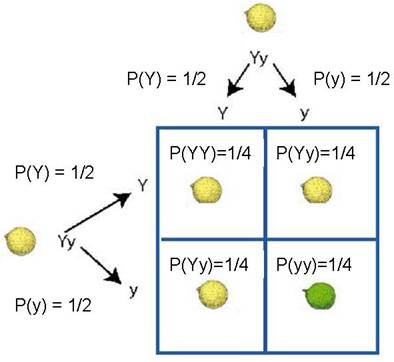
(Image on bottom left: A monohybrid cross example of Mendel's pea plant experiment. He crossed two yellow pea plants, both of which were heterozygous dominant, and they produced 3/4 yellow peas and 1/4 green peas.)

Article: